
Prepare the security review.
Deployment diagrams, data handling, retention, and 20 security answers in one downloadable pack.
Version 1.0 · Reviewed October 4, 2026 · No form required
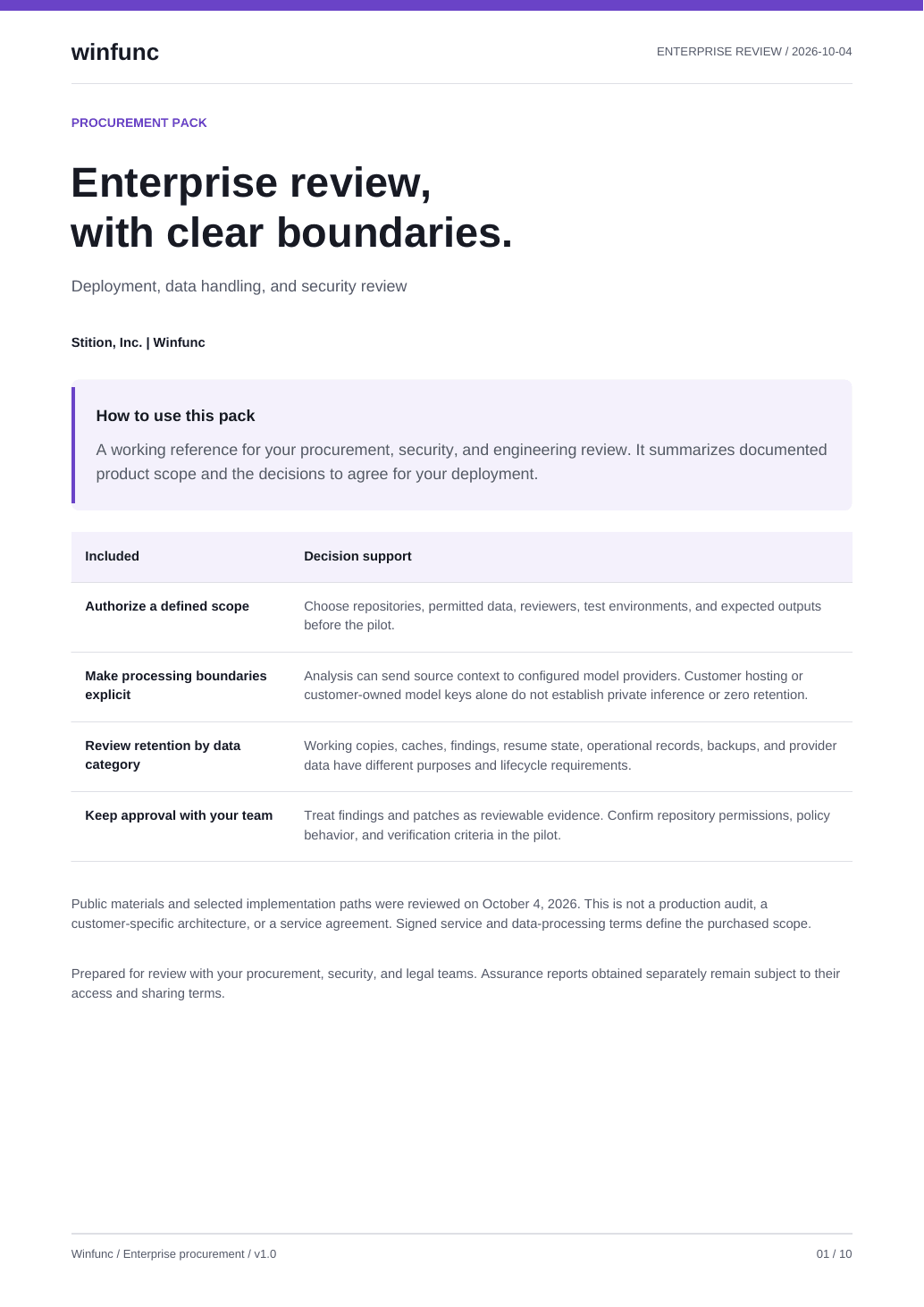
Inside the pack
Deployment and data flow
Conceptual responsibility and provider boundaries.
Retention by category
Working copies, artifacts, resume data, records, backups, and model providers.
Security questionnaire
20 concise answers with evidence status and references.
Procurement checklist
Documents and decisions to agree before access and rollout.
Public materials and selected implementation paths were reviewed on October 4, 2026. This is not a production audit, a customer-specific architecture, or a service agreement. Signed service and data-processing terms define the purchased scope.
Review each data category.
Source working copies, retained evidence, and provider processing have different lifecycles. Agree a schedule for the deployment you choose.
| Category | Reviewed position | Agree for your deployment |
|---|---|---|
| Source working copies and caches | Temporary checkout cleanup exists; source review also identified a repository mirror cache. Do not treat all source storage as transient.[S7] | Agree cache eligibility, deletion timing, failed/cancelled-job cleanup, and any deployment requirement that prohibits caching. |
| Findings, reports, and code snippets | Findings and reports are retained review artifacts and can contain affected code snippets.[S7][S1] | Agree access, ownership, export, retention periods, deletion triggers, and downstream integration copies. |
| Resume state and agent/session traces | Recovery snapshots and local session traces can persist analysis context and transcripts.[S7] | Confirm enabled trace categories, permitted content, access, retention, and removal after completion or cancellation. |
| Accounts, credentials, jobs, and API events | Account and job records persist. API event metadata is distinct from other logs; encrypted onboarding credentials require configured storage controls.[S7][S3] | Agree purpose, access, credential revocation, retention, audit export, and deletion exceptions for each record type. |
| Backups and recovery copies | Backup selection in reviewed source includes application/analysis records and report artifacts; actual deployment policies were not inspected.[S7] | Request backup retention and expiry, deletion propagation, restore-test evidence, RPO/RTO, and responsibility ownership. |
| Model-provider inputs and outputs | Analysis can transmit source context to the configured provider. Provider credentials do not determine retention or training restrictions.[S1][S7] | Agree provider and account, subprocessors, processing region, training-use restrictions, retention eligibility, and deletion terms. |
Common security-review questions
Answers distinguish public documentation, selected implementation evidence, and terms to confirm.
01Who provides Winfunc and which terms govern the purchase?
02How is repository access scoped?
03Where will the service run?
By agreement
Customer-controlled hosting and isolated-environment options are scoped by agreement. Record the selected deployment, infrastructure owner, support and upgrade responsibilities, and permitted integrations.[S1]
04Can source code be transmitted outside the processing environment?
05Can we use our own model credentials?
By agreement
Customer-owned model credentials are an enterprise option by agreement. Confirm supported providers, account ownership, billing, secret handling, and provider restrictions. This alone does not establish private inference or zero retention.[S1]
06Is customer code used to train models?
07Which processing regions and subprocessors apply?
08Is all customer data deleted when a scan ends?
Implementation evidence
No universal immediate-deletion statement is established here. Temporary checkout cleanup differs from source caches, findings, snippets, resume state, session traces, operational records, and backups. Agree each lifecycle using the retention table.[S7]
09How do we request export or deletion?
10What backup and recovery assurances are available?
11How are users authenticated and permissions checked?
12Are SSO and automated provisioning included?
13What isolation applies to our repositories and environment?
By agreement
Repository access checks are implemented in reviewed paths. Dedicated or customer-controlled environments are options by agreement. Review the actual account, network, storage, model, and administrator boundaries; repository authorization is not complete tenant-isolation evidence.[S1][S7]
14How are data and access credentials protected?
15Do logs contain only metadata and provide a complete audit trail?
16What authorizes testing and use of test credentials?
17Who approves patches and changes?
18How do we review SOC 2 assurance?
19Which NDA, DPA, and regulated-data terms apply?
20What incident notification and support terms apply?
Sources and review scope
- S1
- Enterprise options and commercial scope (opens in a new tab)
Current public enterprise options are qualified by agreement.
- S2
- Integrations and workflow availability (opens in a new tab)
Confirm selected integration status, permissions, and workflow scope.
- S3
- Trust Center control summaries (opens in a new tab)
Published summaries; not an independent review of operating effectiveness.
- S4
- Trust Center assurance access (opens in a new tab)
Request current assurance reports; report contents were not inspected.
- S5
- Website privacy policy (opens in a new tab)
Website personal-data practices and rights; service DPA still requires agreement.
- S6
- Website terms of use (opens in a new tab)
Website terms; not a complete enterprise service agreement.
- S7
- Selected implementation evidence
Selected implementation paths at revision 4ff82a8 were inspected read-only on October 4, 2026. Detailed supporting evidence can be reviewed with Winfunc; no production verification was performed.
- S8
- Sample audit and pilot materials (opens in a new tab)
Public research example and a blank pilot scorecard; not customer or production verification.